
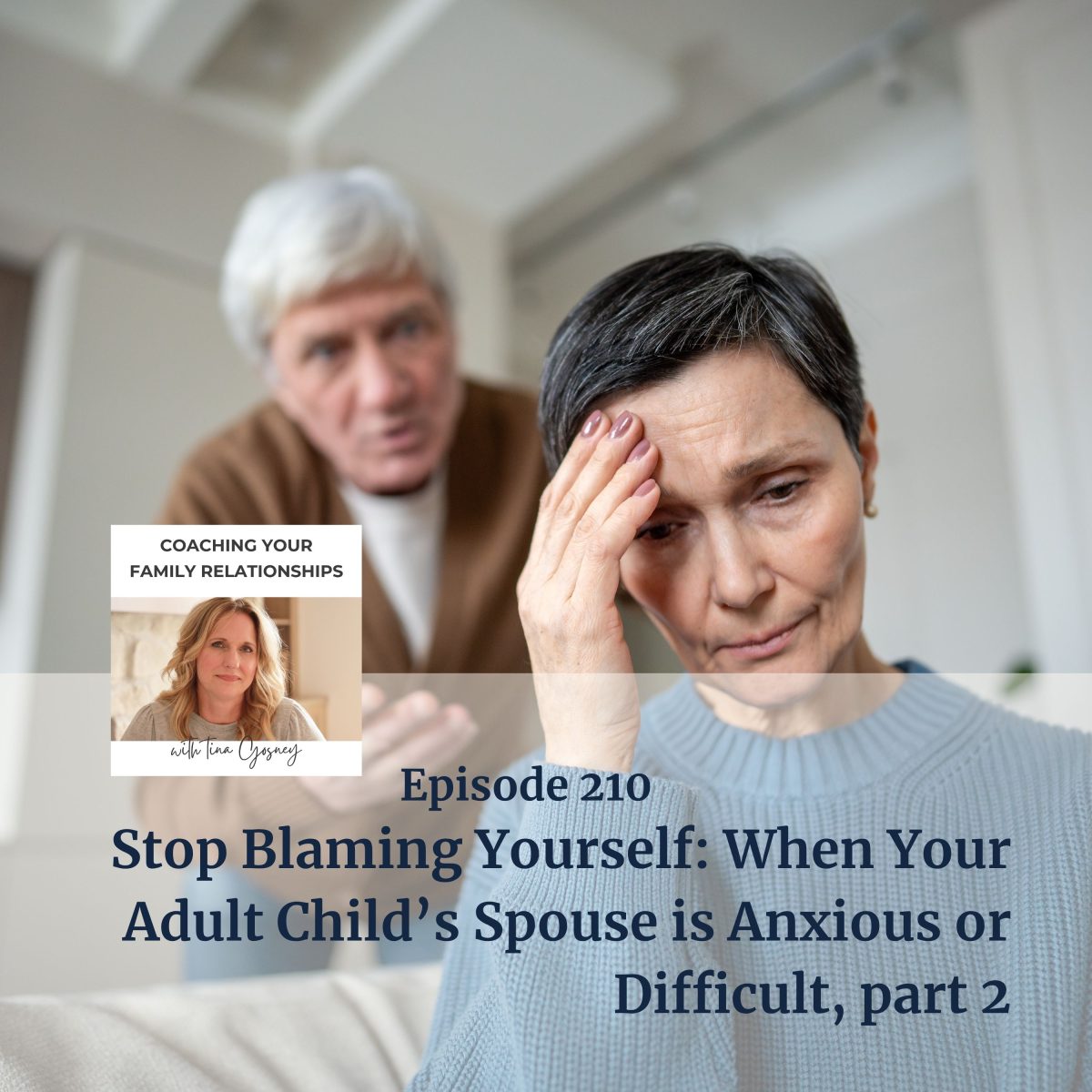
Episode 210 – Stop Blaming Yourself: When Your Adult Child’s Spouse is Anxious or Difficult, part 2
Have you ever left a visit with your adult child and their spouse thinking, “Nothing big happened… so why do I feel awful?” If their spouse is tense, easily offended, or hard to read, many parents slide into a painful pattern: self-blame. You replay every sentence, analyze your tone, and try to “fix” yourself so the relationship won’t feel so fragile.
In Part 2 of this series (Parents + Adult Child + Difficult/Anxious Spouse), Tina breaks down why self-blame is a nervous-system response to family anxiety—and how to move from shame into clarity using a simple family-systems tool.
In this episode, we cover
- Why self-blame shows up when your adult child’s spouse brings anxiety into the family system
- The hidden reason self-blame feels “useful” (even though it hurts)
- How parents start walking on eggshells and over-functioning to keep the peace
- What to do when your adult child brings “feedback” that sends you spiraling
- How to stop carrying what was never yours to carry in the first place
- A practical reset tool: The Three Bins (Own / Influence / Release)
A powerful reminder
Self-blame is not the same as growth.
You can own what’s yours without erasing yourself.
When shame says: “You have to earn your way back,” steadiness says:
“Connection is built through consistency, not perfection.”
Next episode preview
Next, we move into Stage 3: Defensiveness—when self-blame gets exhausting and parents swing into defending, explaining, and trying to prove their intentions. Tina will show you how to step out of defend-and-explain and into calm leadership.
Full Transcript
00:00
Imagine this scenario. Have you ever been there? You’re in the car, just sitting in the driveway, engine’s turned off, and your hands are on the steering wheel, and you’re just gripping on because you’re bracing for impact. You just left brunch with your adult child and their spouse.
00:18
Nothing big happened. There was no fight, there was no scene, no obvious disrespect, but you could just feel your intuition is telling you something really strongly, actually kind of screaming at you that something is wrong. Their spouse was really quiet. They were very tense. They were watching you. You kept trying to be warm. You knew something was happening. It felt tense in the moment, and you tried to make jokes and be warm, but everything just landed flat. And then, you know, you noticed every once in a while, your adult child would turn around and just whisper to them, are you okay? It was like they were managing this fire that you couldn’t see, and you had no idea where it was coming from.
01:01
And now you’re sitting in the car, and your mind starts doing that thing that it does all the time. It’s trying to put the puzzle pieces together. It’s replaying every moment, every piece of the conversation, everything you said, everything you saw, and you’re thinking, Did I say the wrong thing? Was my tone off? Did I bring up the wrong topic? Was I too much or too loud or too enthusiastic, or was I not enough?
01:32
Should I have asked fewer questions or more questions? Why do I always do this and then your brain goes and lands on this common landing place that says, Well, this is probably all my fault.
01:48
Maybe I wasn’t welcoming enough. I was too opinionated. Maybe if I were a better parent, then this wouldn’t be happening right now. So it’s really common to think if I had done things differently when my child was growing up, they wouldn’t be in this marriage, they wouldn’t be so easily influenced, or they wouldn’t feel so distant from me right now. And it’s not just one thought, it’s this whole wave that just comes over you, and those thoughts just come pounding on you over and over and over again, they come so quick it’s hard to even separate them. That’s called shame, regret and fear.
02:30
And our brain likes to land here, because if it’s your fault, then you have maybe the ability to fix it. But if it’s not your fault, do you have any ability to fix anything?
02:45
This is the self blame stage. It can feel like a trap, because it keeps you working harder, while you just keep disappearing inside. Today, we’re going to talk about what self blame really is in an anxious family system, and how to step out of it with steadiness and love and connection.
03:03
Welcome to coaching your family relationships. I’m Tina Gosney, family conflict coach and family life educator. Here, we talk about family relationships through a family systems lens, which means we pay attention to patterns, anxiety, roles and what changes when one person becomes more grounded? And this is the one hope that I always want you to hold on to, when one person in a family becomes more grounded, the whole relationship system can begin to heal.
03:36
This is episode two in a five part series for parents who have an adult child with a difficult or anxious spouse. Today we’re talking about stage two of the apparent emotional journey. Episode 209, last time was the stage where we looked at the confusion stage. So if you want to learn about confusion, and I highly recommend listening to that one before this one, then go listen to two. Just pause this one. Go listen to episode 209, and then come back to this episode. But today is the self blame stage.
04:10
In this episode, we’re going to explore why self blame shows up so powerfully when your adult child’s spouse is anxious, how shame becomes a strategy for control, even though it feels terrible to us, the difference between healthy responsibility and toxic responsibility and a practical mind shift that you can use immediately, especially after tense visits or confusing texts so you stop turning every family interaction into a verdict on your worth. Now, if you have been carrying that quiet, heavy question, is this my fault? Then this episode is for you.
04:55
Here’s what I want you to know about family systems. A family is an emotionally.
05:00
An intricately connected system. Imagine a calm, peaceful body of water. Someone drops a pebble into the water, and then what happens? Well, the ripples start going outward. It disturbs the whole body of water. This is just what happens in an emotional family system. One person can drop in and be the pebble that creates ripples throughout the whole family, and then everybody else starts dropping in pebbles too, and it just becomes more stirred up and more anxiety runs through the family.
05:35
So let’s start with something that I want you to understand very clearly, and that is that self blame is one of the most common ways that parents try to regain stability when a family system feels anxious, it does not mean that you’re weak. It also doesn’t mean that everything your brain is telling you that is your fault is true. It just means your nervous system is trying to find a way that to make sense of something that feels really unpredictable.
06:06
But what is true is that when your your adult child’s spouse brings anxiety into the system, it will often create instability in all the relationships that it just ripples through the family. So plans will change. People will walk on eggshells and the emotional temperature. You never know what it’s going to be. It’s so hard to predict. When humans can’t predict what’s going to happen, we go searching for a reason. We want to know what caused it so that we can control it. And for many parents, that most available control lever is themselves, and so our mind says, If I can find out what I did wrong, then I can prevent this from happening again.
06:52
That’s why self blame feels so strangely compelling and like we like to go there, and it hurts too, but it gives us the illusion that we can control the things that are happening. It gives the illusion of power the alternative, which is recognizing that you can’t control your adult child’s marriage or their spouse’s anxiety that feels terrifying. It feels powerless. So self blame is a way that we avoid that helpless feeling.
07:22
But self blame does not actually create a steady, healthy influence in your family. What it does create is over functioning, that means you’re stepping into roles and into situations and trying to manage things that are not yours to manage, and over functioning can look like trying to be the perfect host, constantly editing yourself, apologizing for things that you didn’t do, seeking reassurance from your child? Are we okay? Over explaining yourself, bending over to keep the peace, trying to prove, hey, I’m a safe person. You can be here with me.
08:05
The thing about over functioning is that when we do that, there’s always an equal balance on the other side, which means somebody is else is under functioning. And so we are taking on things that are not responsibility, our responsibility, and we’re taking them from them, so which means it’s not allowing them to grow because we’re taking it from them. So all of this will increase anxiety in the system. It doesn’t lower it. We think that we’re trying to lower it. We think that’s what we’re doing. We’re actually increasing it. Because anxious systems don’t calm down with more effort. They calm down with more steadiness and more groundedness.
08:47
There’s also something else here that’s happening that’s that’s really important. So when your adult child feels caught between their spouse and their family of origin, they experience what’s called a double bind. They experience this internal conflict. They’re not going to win with either choice. So instead of facing that conflict directly, the emotions and the emotional system that anxiety, it’s looking for a place to discharge and you as the parent, especially a caring, conscientious parent, you are an easy landing place to park that anxiety
09:30
that’s hard, right? Because you care, because you’re self reflective, because you’re willing to adjust and take it on. So you become the one that’s doing the emotional labor, and everyone else gets to stay defended, and they get to stay protected.
09:47
Let’s talk about a key distinction. There’s healthy responsibility and there’s toxic responsibility. Healthy responsibility says I can own my part.
10:00
I can repair when I need to. I can learn and I can grow in this relationship,
10:05
toxic responsibility says if there’s tension, it’s because I failed. If they’re upset, I need to fix it. It’s my job to fix it. If they distance themselves, I have to earn my way back.
10:21
Do you hear the difference. Healthy responsibility creates maturity. Toxic responsibility creates anxiety. It drops more pebbles into the water to create and stir and up. Stir that up. The tricky part is that conscientious, conscientious parents will often confuse healthy responsibility with toxic responsibility. And why do we do that?
10:48
Well, you’ve spent so many years being the stable one, the one who thinks ahead, who tries to avoid those roadblocks, the one who keeps things together and when the system gets shaky,
11:04
you do what you’ve always done. You take responsibility.
11:09
But this is a season of life that calls for something different your child, your adult child, is in a different stage of development, and it requires a different response from you. And when you go to your old patterns that can very easily lead into self abandonment for you and limiting the growth and development of your adult child. And I want to help you stop doing that.
11:35
Let’s go through a real life family example. Let me share this example that might feel familiar. There was a dad that I worked with. I’m going to call him Steve. He had a son who was married to someone with a lot of anxiety, and that spouse’s anxiety showed up as criticism, controlling the schedule, a tendency to interpret just neutral comments as insults. And then Steve told me, Hey, Tina, every time we’re together, I feel like I failed a test I didn’t even know I was taking. He described a holiday dinner where he made a simple comment. He just said, We’re so glad that you made it.
12:14
And then his later, after it was all over, his son texted him and said, Hey, I just want you to know when you said that it came across that you were surprised that we showed up, and that really hurt her feelings. And then Steve spiraled.
12:32
He told me I didn’t mean it that way, but I guess I always am saying the wrong thing. Maybe I’m just an insensitive person. Maybe I’ve always been insensitive. He was doing this because he was trying to prevent future problems. So if he was more careful about how he worded his invitations or his comments, then he could control the situation. If he stopped making jokes and he stopped asking questions about their life because he didn’t want to sound intrusive, then he would control the situation. So we just started preemptively apologizing. He would say things like, Hey, I’m sorry if this sounds weird, but or I’m sorry if this was too much. But
13:16
he got so careful that he didn’t even know what to say anymore. He was walking on eggshells all the time.
13:24
Here’s what happened. Do you think his daughter in law relaxed? No, the daughter in law actually became more vigilant, because hyper vigilance often escalates when people feel like others are trying too hard, and then his son was caught in the middle. He’s relaying feedback to his dad, instead of addressing the dynamic in his marriage directly, it felt safer to him to address this in his parents than to address this in his wife. And Steve just kept getting smaller and smaller and more ashamed and more anxious and more desperate.
14:02
So as usual, when we’re working together, we have to slow things down and we have to take a bird’s eye view to see what’s really happening in the family system.
14:13
Steve realized he wasn’t making normal mistakes and repairing he was living in this invisible court system where any tension just meant that he was the guilty one. So we worked on two things. We had to separate the facts from his interpretation of the facts, and he had to start building this steady internal groundedness that did not require his daughter in law’s approval so that he could feel okay. That’s what moved him out of self blame. He didn’t harden himself. He didn’t have to cut them out, but he had to return to his internal, grounded responsibility. Here’s a practical mindset shift that you can try.
14:57
I want you to move from what did I.
15:00
You wrong into what’s mine to own and what’s not mine to own?
15:06
So that question is really powerful. It brings you out of shame and into clarity.
15:13
Let’s make it really practical. I’m going to give you a simple tool you can use right after anything, a visit, a phone call, a text exchange. It’s called the three bins. Grab a piece of paper if you want, but you can also do this in your head. Bin number one. This is called what I own. This is where you put anything that is truly yours and only yours. Maybe you were sharp, you interrupted, you made a comment that you regret. You avoided having a conversation that you needed to have. You didn’t ask for what you needed. You didn’t put a boundary into place when you needed to. If it’s yours, don’t deny it. Don’t defend it. Also don’t shame yourself. Just simply own it. Healthy ownership. Sounds like you’re right. I can see how that landed, and I’m sorry. I am really working on being more thoughtful.
16:08
It’s simple, it’s clean, it doesn’t grovel.
16:12
Okay, here’s bin number two, what I can influence. This is where you put things that allow you to influence the emotional family system, how you communicate invitations, how you manage your own anxiety, how you respond when your adult child gives you feedback, that’s a difficult one, and what boundaries you kindly hold now, influence is where your power lives. This is not in fixing them, but what you contribute into interactions.
16:41
Then number three, what I release, this is the biggest bin for most parents in this situation, and this is where you put the relationship that your adult child has with their spouse, that spouse’s anxiety and their interpretations,
17:00
whether they’re pleased with you, whether they choose closest closeness with you. Right now, their decisions about visits, holidays, timing and loyalty, releasing these things don’t mean that you don’t care about them and you don’t care about their relationship with them. It means you stop carrying what was never yours to carry.
17:22
The most important part is that when self blame shows up and it tries to take items from bin number three, and it’s going to try to shove them into bin number one, so it’s going to try to take things that are not yours to carry and make them your responsibility. It tries to make you responsible for their emotional state. So when you fill that self blame spiral, you should pause and say out loud, if you can, that’s not mine,
17:55
and then come back to your grounded statement of, I can be loving and I can be steady, even when someone is anxious. Let me give you a specific example of how this might sound in real life. Okay, so if your adult child says, Sarah felt judged when you asked about their job,
18:14
your self blame response might be, oh, no, I’m sorry. I will never ask again. I didn’t mean it. Please tell them I’m sorry I’m so terrible at this.
18:23
A grounded response, a healthy response might sound like thank you for telling me that I wasn’t trying to judge. I was trying to connect. I really wanted to know about their job. I can be more mindful of my tone, and I also want us to be able to talk like a family without having so much fear around everything that we say, I really love you and I want our relationship to stay strong.
18:46
Do you hear the difference? Grounded responsibility says I can adjust my part without abandoning myself into shame and self blame, and that is the goal. You’ll feel, that temptation to go back into self blame, especially if closeness with your adult child feels like it’s on the line. And remember, that’s a protective move. It’s trying to say, I can control this if I take the blame. So let me offer one more anchor for you when shame says you have to earn your way back into their life, steadiness and connection, says connection is built through consistency, not perfection.
19:29
So consistency, warmth and clarity over time that matters way more than getting every moment right and saying the right words,
19:40
if you are in the self blame stage, I want you to hear this, you can be a good parent and still have a complicated relationship with your adult child.
19:52
You can have done many things right and still be experiencing distance. You can.
20:00
Love your adult child deeply, trying to show up as your best self and still not be able to control how their spouse interprets you.
20:10
Self blame is not the same thing as growth. Self blame is a form of anxiety.
20:17
The way to get out is not blaming the spouse harder or blaming yourself harder. The way to get out is being more clear on your part and strengthening your capacity to stay steady when other people are not.
20:32
And if you’re thinking,
20:35
But Tina, what if I really did mess things up over the years? Well, I’m going to tell you, then you’re normal. And yeah, you can own what’s yours repair what is repairable. But don’t confuse repair with self erasure,
20:53
because your adult child and their spouse do not need you to shrink. They need you to be a steady, emotionally safe person that does not mean perfect, it just means steady.
21:06
Here’s the hope that I have seen over and over again. I want to leave you with this hope when parents stop chasing approval and start practicing grounded connection, adult children often begin to relax. It does not happen quickly. It does not happen in a straight line. It is not linear progress, but systems respond to steadiness.
21:31
If this episode has stirred something tender for you, then just take the next right step, sort out the bends own what’s yours, and release what’s not and then bring your calm, steady self back into the room.
21:45
In part three of this series, the next episode, we’re going to move into stage three, which is defensiveness, because when self blame gets exhausting, and it does, many parents will swing over the other direction and think, Wait, I’m not the problem, you’re the problem. And they start defending and explaining and trying to prove their intentions. We’re going to talk about how to get out of the defend and explain mode and into calm leadership.
22:13
Thanks for listening today. I want you to remember that you don’t have to do this perfectly. You just need to keep showing up and learning so that you can grow, because when one person in a family becomes more grounded, the whole relationship system begins to heal. This is coaching your family relationships, and I’m Tina Gosney. If this episode has landed for you, subscribe and follow this podcast and share this episode with a friend who needs to hear it.